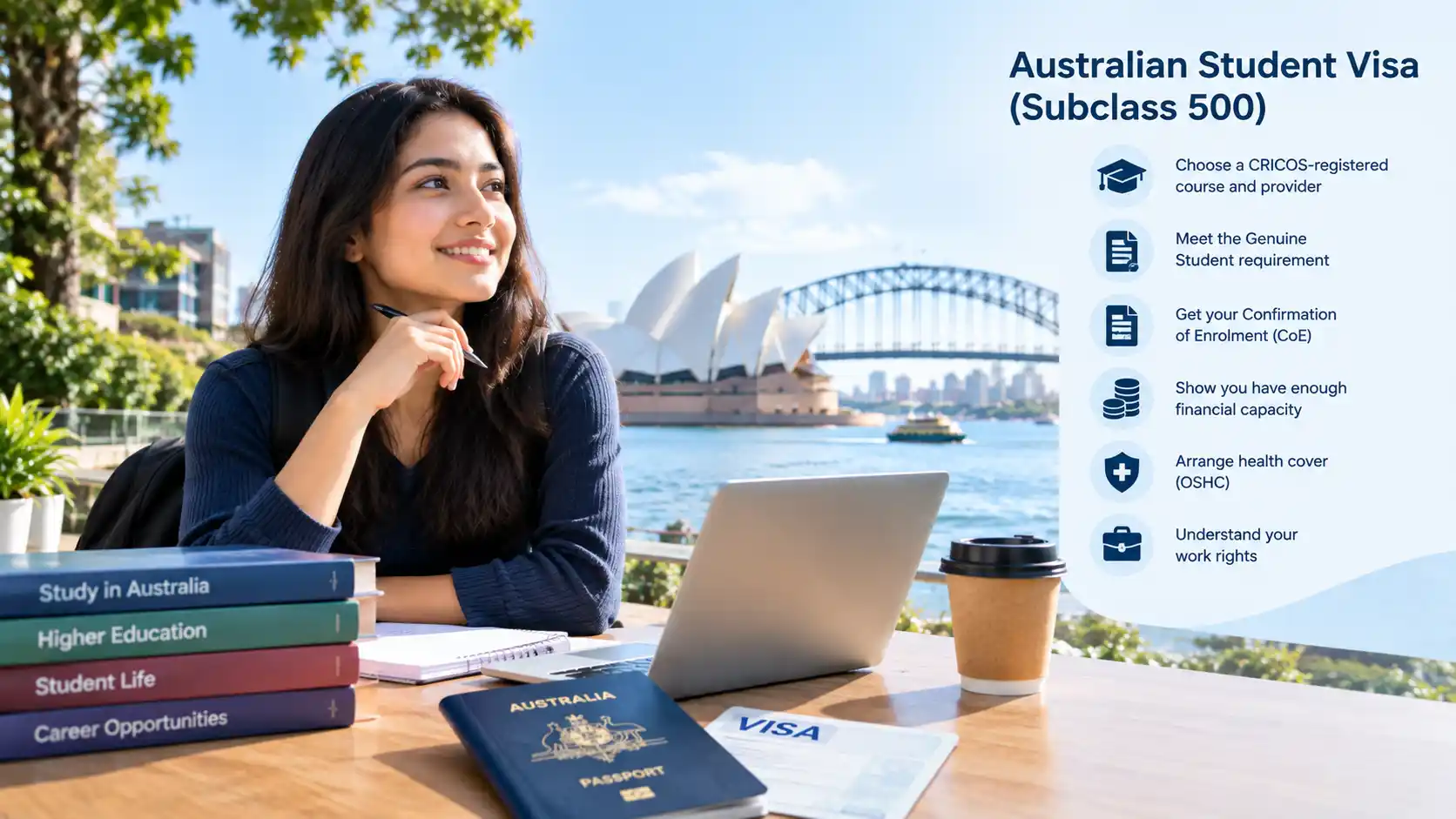
The Student visa (subclass 500) is the main visa used by international students who want to undertake eligible study in Australia. Whether you need this visa depends on your citizenship, current visa and study circumstances.
The visa covers a wide range of registered courses, including vocational education and training (VET), English-language study, higher education and postgraduate research.
This guide explains the main Student visa requirements, what you may need before applying, current work restrictions, ongoing visa obligations and some important points about changing courses or planning for further study after graduation.
What the Student Visa Subclass 500 Covers
The Student visa allows eligible international students to stay in Australia for the purposes of undertaking a registered course of study.
Depending on your circumstances, the visa can also allow eligible family members to accompany you or apply as subsequent entrants.
Your visa conditions can cover matters such as:
- the course you are permitted to study
- work restrictions
- course progress and attendance requirements
- health insurance
- changes to your enrolment or education provider
- conditions applying to accompanying family members
The length of your stay depends on your course and the visa granted to you. Do not assume that the visa will simply remain valid for the entire period you expect to spend in Australia.
You can check your actual visa expiry date, period of stay and conditions through VEVO once your visa is in effect.
Who Needs a Student Visa?
Most international students who are not New Zealand citizens need a Student visa to undertake eligible study in Australia.
New Zealand citizens have different arrangements for entering and staying in Australia and generally do not apply for a Student visa simply to study.
Your circumstances can also depend on the visa you currently hold and the type of study you intend to undertake. If you are already in Australia, check whether your current visa allows the proposed study before making an enrolment decision.
For students applying for a Student visa, the intended course generally needs to be registered on CRICOS, the Commonwealth Register of Institutions and Courses for Overseas Students.
Check the specific institution and course rather than assuming that every course offered by a registered provider is available to international students. You can search the official CRICOS register to confirm the provider and course.
The Genuine Student Requirement
The Genuine Student (GS) requirement applies to Student visa applications and replaced the former Genuine Temporary Entrant (GTE) requirement for applications lodged from 23 March 2024.
The assessment considers your circumstances and your reasons for undertaking the proposed study in Australia. It also considers matters such as the value of the course to your future and other relevant information in your application.
Your GS responses should explain your own circumstances and study plans clearly. They should also be consistent with the information and supporting evidence you provide.
For example, if you are changing fields, moving to a different qualification level or returning to study after a significant period away from education, explain why the proposed course makes sense for you.
What You Need Before Applying
Confirmation of Enrolment
A Confirmation of Enrolment (CoE) confirms your enrolment in a registered course.
For a standard Student visa application, you generally need to provide a valid CoE for your intended study. If you are planning a package of courses, check the document requirements carefully and make sure the correct provider and principal course information are included.
Home Affairs’ Document Checklist Tool provides an indication of the evidence you may need. The department can also request additional evidence during processing.
Before lodging your application, check:
- your name and personal details
- course name
- course dates
- education provider
- CRICOS information
- whether the details match your visa application
Financial Capacity
If financial evidence is required for your application, you may need to demonstrate access to enough money to cover the relevant costs of studying and living in Australia.
The financial-capacity requirement can include funds for:
- travel costs
- 12 months of living expenses
- tuition fees
- tuition fees for accompanying family members
- school costs for school-aged dependants, where applicable
Home Affairs’ current Document Checklist Tool confirms these categories.
The current annual living-cost figure for the primary student is AUD $29,710. This is only one component of the financial requirement, not the total amount you should assume you need for your application.
If you rely on recent deposits, funds provided by a family member or another source of financial support, be prepared to explain the source of the money and provide the evidence requested by Home Affairs.
Do not assume that a particular number of months of bank statements is a universal visa requirement.
English Language Requirements
If you are required to provide evidence of English proficiency, you must meet the Student visa English requirement through an approved test or qualify for an applicable exemption.
The approved English tests and requirements changed on 7 August 2025. For visa purposes, Home Affairs currently lists approved tests and visa-specific score requirements rather than applying one universal English rule to every applicant.
For many Student visa applications, the standard IELTS minimum is 6.0, with lower thresholds available in specified ELICOS, foundation and eligible pathway arrangements.
The exact requirement can depend on your circumstances and the course arrangement.
Do not book a test based on an old IELTS, PTE or TOEFL requirement. Check the current Student visa English language requirements and your education provider’s admission requirements separately.
Also note that Home Affairs does not accept English tests that are delivered completely online or remotely for visa purposes.
Health Insurance
Most Student visa applicants need Overseas Student Health Cover (OSHC).
Your OSHC needs to meet the requirements that apply to your Student visa. Home Affairs requires OSHC for the required period of cover, and the policy expiry date can affect the period for which the visa is granted.
Your education provider may arrange OSHC as part of your enrolment, or you may arrange an approved policy yourself.
Before purchasing cover, check:
- the provider
- the policy type
- the start and expiry dates
- who is covered
- whether family members are included
- what services are covered
Do not assume that a policy should begin only on your first class date. Check that the dates provide the cover required for your visa.
Health and Character Requirements
Depending on your circumstances, Home Affairs may require health examinations, police certificates or other character information.
The requirements can vary according to factors such as your circumstances, travel history, intended stay and proposed activities in Australia.
Do not assume every applicant will need the same medical or police documents. Follow the document requirements generated for your application and respond to any requests from Home Affairs.
How Much Does the Student Visa Cost?
Visa application charges change, so an old fee table should not be used when budgeting for your application.
From 1 July 2026, the standard base application charge for a Student visa is AUD $2,500 for the primary applicant, subject to applicable concessions and different charges that may apply in particular circumstances.
Additional applicant charges can apply when family members are included in the application. The total also depends on the circumstances of the application.
Home Affairs advises applicants to use the current Visa Pricing Estimator and Visa Pricing Table because visa charges can change and different components can apply.
| Cost | What to consider |
| Student visa application charge | Standard base charge is AUD $2,500 from 1 July 2026, subject to applicable rules |
| Additional applicants | Additional applicant charges may apply |
| OSHC | Varies according to provider, policy, period of cover and circumstances |
| English test | Cost varies by test provider and location |
| Medical examinations | May apply depending on your circumstances |
| Police certificates | May apply depending on your circumstances |
| Tuition | Set by your education provider and course |
| Living costs | Depend on your location, accommodation and circumstances |
Do not treat the visa application charge as the total cost of moving to Australia. Tuition, OSHC, accommodation, travel and everyday living expenses can be substantially higher.
Student Visa Work Rights
Student visa holders generally cannot work more than 48 hours in a fortnight while their course is in session.
For this condition, a fortnight is a period of 14 days beginning on a Monday.
Different rules can apply during permitted course breaks. Students undertaking a master’s by research or doctoral degree can also have different work arrangements once their course has commenced.
Your actual visa conditions are what matter, so check them through VEVO and the current Home Affairs Student visa guidance.
The 48-hour limit applies across your work
If you have more than one job, the limit does not reset for each employer.
For example, working 30 hours for one employer and 20 hours for another does not give you 50 hours of permitted work. You need to consider your combined hours.
The same caution applies to different types of work. Do not assume that using an ABN, working as a contractor or undertaking gig work automatically removes the Student visa work restriction.
If you are unsure whether a particular activity counts as work under your visa conditions, check the current rules before accepting the work.
What about exam periods?
An exam period is not automatically the same as an official course break.
Do not stop applying the work limitation simply because regular classes have finished. Check your education provider’s official course calendar and the visa conditions that apply to you.
Keeping Your Student Visa Valid
Getting the visa is only the beginning. You also need to comply with its conditions while you are in Australia.
Your responsibilities can include:
- remaining enrolled in the required registered course
- maintaining the required course progress
- meeting the attendance requirements that apply to your course and provider
- complying with your work limitation
- maintaining the required OSHC
- keeping your personal and contact information up to date as required
- complying with any other conditions attached to your visa
There is not a universal 80% attendance rule that applies to every Student visa holder. Attendance monitoring can depend on the sector, course and education provider.
Course progress is also important. If you are struggling with your studies, speak with your provider early rather than waiting until you receive a formal warning.
Think carefully before changing your course or provider
Changes to your enrolment, course level, education provider, study load or course progression can have visa implications.
Before changing anything, check:
- whether your new course satisfies your visa conditions
- whether the new course is registered on CRICOS
- whether you need a new CoE
- whether your current provider has transfer or release requirements
- whether the change affects your visa period or future visa options
Do not withdraw from your existing course first and try to resolve the immigration consequences afterwards. Your education provider can explain its own enrolment and transfer procedures, while Home Affairs should be used for the visa requirements.
If you are comparing qualification levels before making a course decision, see Certificates, Diplomas, and Degrees: What’s the Real Difference?.
For students comparing vocational and university pathways, VET vs University: Which Pathway Actually Pays Off in Australia? provides further information.
What to Check Before You Lodge Your Application
Before submitting your Student visa application, review the whole application rather than checking documents one at a time.
Make sure:
- ☐ Your course and provider are registered on CRICOS
- ☐ Your CoE information is correct
- ☐ Your GS responses accurately describe your circumstances
- ☐ Your financial evidence covers the requirements that apply to you
- ☐ Your English evidence meets the current visa requirement, if required
- ☐ Your OSHC arrangements are correct
- ☐ Your health and character documents are provided where required
- ☐ Your passport and personal details are correct
- ☐ Family members have been declared correctly, where applicable
- ☐ All information is consistent across your application and supporting documents
If something in your circumstances is unusual, do not try to hide it by leaving out relevant information. Study gaps, previous visa refusals, changes of study direction or unusual financial arrangements may need to be explained clearly and supported by appropriate evidence.
A complete and accurate application is more useful than one that simply contains a large number of documents.
Frequently Asked Questions
Can I apply for a post-study work visa after completing a VET diploma?
Some graduates with an eligible VET qualification may be able to apply for the Temporary Graduate visa (subclass 485) under the Post-Vocational Education Work stream.
Eligibility is not automatic simply because you completed a CRICOS-registered diploma.
Do not choose a VET course solely because you expect it to lead to a subclass 485 visa. Check the current Temporary Graduate visa (subclass 485) requirements before enrolling.
If you are considering different diploma levels, you can also read Exploring Different Types of Diplomas.
Can I move from a lower-level VET course to a higher-level course while holding a Student visa?
A change to a higher-level course may be possible, but you must comply with your Student visa conditions and the requirements of your education provider.
What happens if I fail multiple units during my VET course?
Failing units can affect your course progress and may lead to intervention by your education provider.
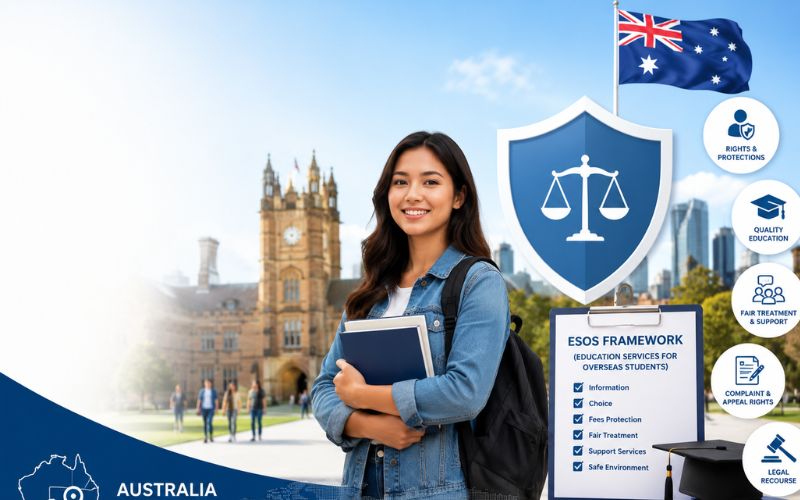
If you do not meet the course-progress requirements that apply to your course, the provider may have reporting obligations under the ESOS framework after following the required notification, support and complaints or appeals processes.
Can my family come with me on a Student visa?
Eligible family members can generally be included as secondary applicants or may apply as subsequent entrants, depending on the circumstances.
Existing family members must generally be declared in the primary Student visa application, even if they do not intend to travel to Australia immediately.
Can I work unlimited hours during my semester break?
Student visa holders can generally work unlimited hours when their course is not in session, subject to their visa conditions.
The key issue is whether the period qualifies as a course break under the applicable visa conditions.
Can I change my education provider after arriving in Australia?
You may be able to change providers, but transfer requirements can apply, particularly during the early part of your principal course.
Your current provider may have its own release or transfer procedures, and the proposed course must also comply with your Student visa conditions.
How can I check the conditions on my Student visa?
Once your visa is in effect, you can use VEVO to check your visa type, expiry date, period of stay and conditions.
This is useful when you need to confirm your work rights or other conditions rather than relying on an old email, website article or advice from another student.
Important: Student visa fees, English requirements, financial-capacity amounts, work conditions and other immigration rules can change. This article was updated in September 2026. Always check the current requirements with the Department of Home Affairs before lodging an application, starting work or changing your course.