Planning to study in Australia involves more than choosing a course and applying for a visa. You need to check that your course is available to international students, understand the Student visa requirements, arrange health cover and prepare for the costs of moving and living in Australia.
This checklist covers the main things to organise before you apply, before you travel and after you arrive.

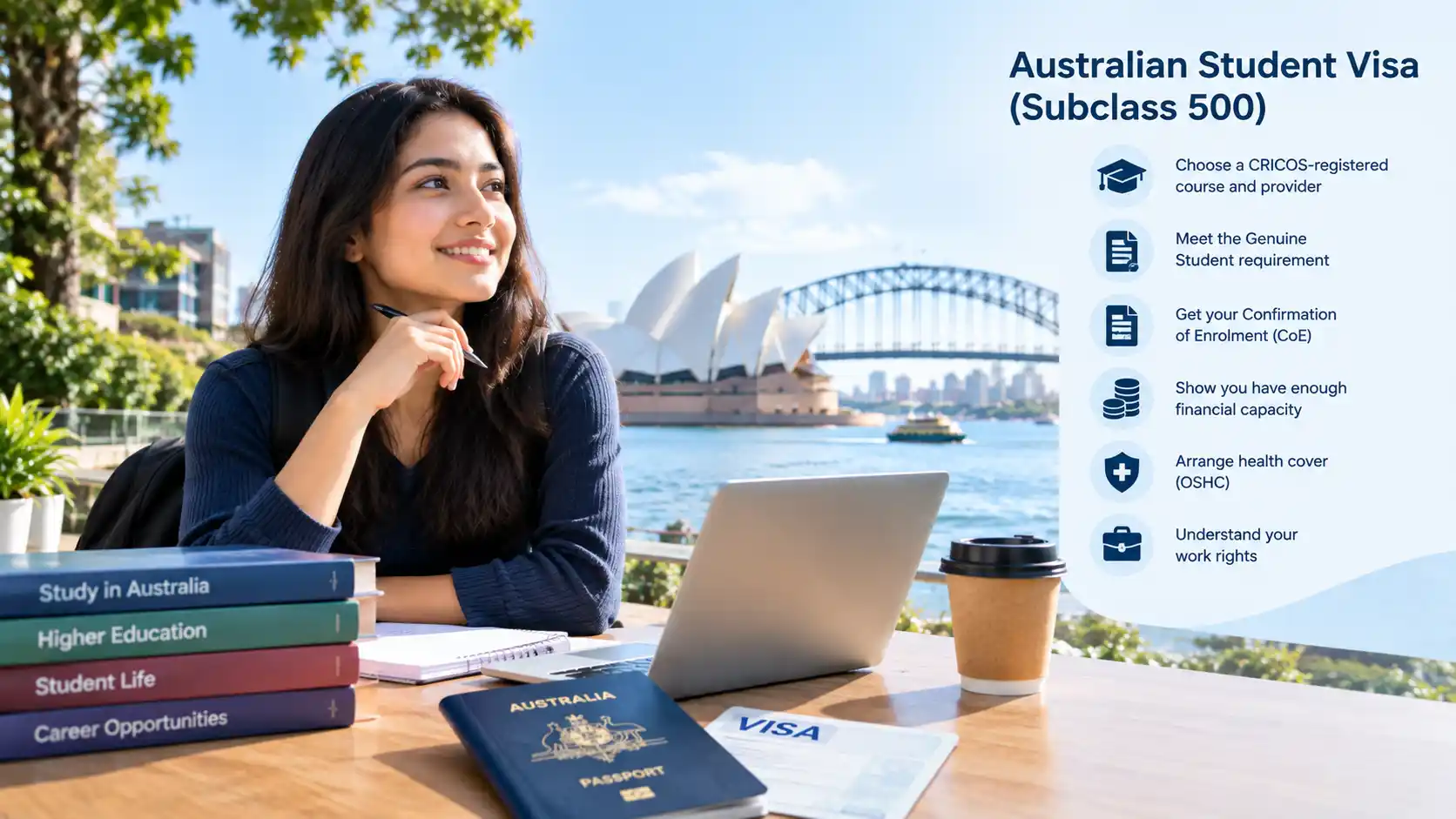
Confirm Your Institution and Course Are on CRICOS
Before paying a deposit or making your visa application, check that your intended institution and course are registered on the Commonwealth Register of Institutions and Courses for Overseas Students (CRICOS).
CRICOS is the official Australian Government register of education providers and courses available to people studying in Australia on student visas.
Check both:
- the education provider
- the specific course you intend to study
- the course location, where relevant
- the course registration details
Do not assume that every course offered by a registered provider is available to international students. Confirm the specific course on the current CRICOS register.
Checklist: ☐ Provider checked ☐ Course checked ☐ Location checked
Understand the Genuine Student Requirement
If you are applying for an Australian Student visa, you need to meet the Genuine Student (GS) requirement.
The GS requirement replaced the former Genuine Temporary Entrant (GTE) requirement for Student visa applications lodged from 23 March 2024.
As part of the visa application, you may need to answer questions about matters such as:
- your current circumstances
- why you chose the course and education provider
- how the course benefits you
- how the proposed study fits with your previous education and circumstances
- other relevant information supporting your application
Your answers should be specific to your circumstances and consistent with the information and evidence provided in your application.
Avoid relying on generic statements such as wanting to study in Australia because it offers a high-quality education system. Explain why your particular course and study plans make sense for you.
If your proposed course is different from your previous studies or work experience, explain the reason clearly rather than leaving an apparent change unexplained.
Practical tip: Do not copy a GS response from another student or use a generic template without adapting it to your circumstances. Your application should accurately explain your own study plans and circumstances.
Get Your Confirmation of Enrolment Before Applying
Once you have accepted your course offer and completed the enrolment requirements set by your education provider, the provider can issue your Confirmation of Enrolment (CoE).
For a standard Student visa application, you generally need to provide a valid CoE for your intended study. If your study plan involves more than one course, you need to provide the CoE details for each intended course.
Before lodging your application:
- ☐ Accept your course offer
- ☐ Complete the provider’s enrolment requirements
- ☐ Receive your CoE
- ☐ Check your name, course and dates
- ☐ Make sure your visa application information matches your enrolment documents
For help understanding the enrolment process, see the Admission Process at IIS.
Check the Current Financial Capacity Requirements
You need to be able to demonstrate that you have access to enough money to meet the financial-capacity requirement for your Student visa application when this requirement applies to you.
The current annual living-cost amount used for the Student visa financial requirement is AUD $29,710 for the primary student. Additional amounts apply for accompanying family members, including AUD $10,394 for a partner or spouse and AUD $4,449 for each dependent child. Schooling costs can also apply for school-aged children. Check current Student visa requirements from Home Affairs
Financial requirements can also involve other costs, including:
- tuition fees
- travel costs
- school costs for school-age children travelling with you, where applicable
- living costs for accompanying family members
Do not treat the living-cost figure as the total amount you need for your move to Australia. It is only one component of the financial requirement.
Check the current financial-capacity requirements immediately before lodging your application because the amounts and evidence requirements can change.
Arrange Overseas Student Health Cover
Overseas Student Health Cover (OSHC) is a requirement for most Student visa holders, subject to applicable exemptions.
You need appropriate OSHC for the required period of your Student visa. The Department of Home Affairs takes the expiry date of your OSHC into account when determining the visa period.
Your education provider may arrange OSHC for you as part of your enrolment, or you may be able to purchase an approved policy yourself. Check what your provider has included before buying another policy.
OSHC premiums vary according to the provider, policy type, period of cover and your circumstances, so check current prices rather than relying on an old estimate.
Also check what your policy actually covers. Standard OSHC is not the same as Medicare, and services such as dental and optical treatment may not be covered under a basic policy.
Checklist: ☐ OSHC arranged ☐ Dates checked ☐ Policy coverage understood
Check Your Student Visa Work Conditions
Student visa holders generally cannot work more than 48 hours in a fortnight while their course is in session. A fortnight means a period of 14 days beginning on a Monday.
Different rules apply when your course is not in session. There are also specific exceptions for certain mandatory course-related work and for students undertaking a master’s degree by research or doctoral degree.
The important point is that your visa conditions determine what you can do. Check your current visa conditions before starting work.
What about working under an ABN?
Having an Australian Business Number (ABN) does not automatically remove your Student visa work restrictions.
If you work as a contractor, sole trader, delivery driver or through another gig-work arrangement, do not assume that invoicing instead of receiving a normal payslip means the activity falls outside your visa conditions.
If you are unsure whether particular work counts towards your work limitation, check the applicable visa conditions before taking on the work.
Keep a record of your work arrangements and hours so you can monitor your position.
Important: A breach of a visa condition can have serious immigration consequences. An ABN is a business or tax identifier, not an exemption from your visa conditions.
Checklist: ☐ Visa work condition checked ☐ Hours monitored ☐ ABN arrangements understood
Set Up Your Australian Bank Account
Some Australian banks allow eligible international students to begin the account-opening process before arriving in Australia.
The requirements and timing vary between banks. You may need identification and enrolment or visa information, depending on the bank and account.
Before choosing a bank, check:
- whether you can apply from overseas
- what identification is required
- when you can access the account
- whether there are account fees
- how you will receive your debit card
- whether the account suits your expected salary and everyday expenses
Plan for Your First Month of Living Costs
Your first few weeks in Australia can require more money than your normal weekly budget.
You may need to pay for:
- temporary accommodation
- a rental bond
- rent in advance
- food and groceries
- local transport
- a phone or internet service
- household items
- course-related expenses
- other moving costs
Rental rules are not identical across Australia. Bond limits, rent-in-advance rules and other tenancy requirements vary between states and territories.
Do not rely on a general rule such as “four weeks’ bond plus two weeks’ rent” without checking the rules where you will live.
Accommodation costs also vary substantially between cities, suburbs and property types. Instead of relying on an old national price estimate, research current rental and room prices for the specific area where you plan to study.
Practical tip: Budget for temporary accommodation as well as your longer-term rental. Having somewhere to stay for your first few days gives you time to inspect accommodation and understand the local area before committing to a rental arrangement.
For students settling in Sydney, the international student guide to Sydney provides additional information about life as an international student.
Be Careful With Rental Scams
New international students can be attractive targets for rental scams, particularly when they are trying to secure accommodation from overseas.
Be cautious if someone:
- demands payment before you can verify the property
- refuses reasonable requests to inspect the property
- asks you to transfer money to an unusual account
- pressures you to make an immediate decision
- offers a property at a price that seems unusually low
- cannot provide a legitimate rental agreement or clear information about the property
Use reputable accommodation providers or rental platforms, and understand the tenancy rules that apply in your state or territory.
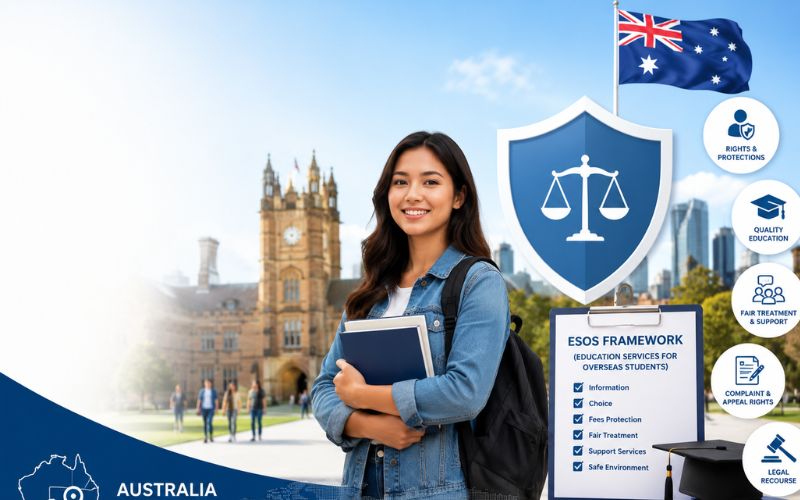
Know Your Rights Under the ESOS Framework
The Education Services for Overseas Students (ESOS) framework provides legal protections and sets obligations for education providers that enrol international students in Australia.
Your education provider has obligations relating to areas such as enrolment, course delivery, student information and complaints processes.
Provider default is one area worth understanding. If an education provider defaults and cannot meet its obligations, the provider may need to arrange for affected students to continue their studies with an alternative provider or provide a refund of unspent tuition fees, depending on the circumstances.
The Tuition Protection Service (TPS) assists eligible international students affected by education provider defaults.
If you have a problem with your education provider, first check its internal complaints and appeals process. If the matter cannot be resolved, identify the appropriate external complaints or appeals body for your provider and state or territory.
Sort Out These Things Before You Travel
Some tasks are easier to organise before you leave your home country.
Check English-language requirements
If your course or visa application requires evidence of English proficiency, check the current requirements and accepted tests.
The approved English tests for Australian visa purposes changed on 7 August 2025. For Student visa applications, the exact test and score requirements depend on the visa rules and your circumstances.
Book any required test early enough to allow for the test date, results and any retake you may need.
Do not rely on an old score requirement. Check the current requirements for both your visa application and your education provider’s admission requirements separately.
Home Affairs does not accept evidence from English tests delivered completely online or remotely for Australian visa purposes.
If you are preparing for an English test, you can also review the General English Course Sydney course information.
Check health and vaccination requirements
Some courses have additional health, vaccination, screening or placement requirements.
This can apply particularly to courses involving areas such as:
- childcare
- aged care
- nursing
- healthcare
- clinical placements
- other regulated or practical environments
Ask your education provider what evidence you need and when it must be provided. If vaccinations or health checks are required, organise the relevant records before travelling where possible.
Apply for a Tax File Number if you are eligible to work
If you are eligible to work in Australia, you can apply for a Tax File Number (TFN) through the Australian Taxation Office.
A TFN is used for tax and employment purposes. You do not need to treat it as a pre-arrival visa requirement. Apply when you are eligible and allow time for processing. If further processing is required, the ATO advises that a TFN application can take longer.
Keep Your Visa and Enrolment Details Up to Date
After arriving in Australia, your responsibilities do not end when your visa is granted.
Keep track of:
- your visa conditions
- your passport and visa details
- your course enrolment
- your course progress
- attendance requirements that apply to your course
- changes to your course or education provider
- your contact details
- your OSHC
- your work hours
If your circumstances change, do not assume that you can simply make the change and deal with the visa implications later. Check the relevant requirements first.
If you are still deciding between different types of study, the guide on VET vs University in Australia may help you understand the different study pathways.
Frequently Asked Questions
Can I bring my spouse or children with me on a Student visa?
Eligible family members can generally be included in a Student visa application or may apply later as subsequent entrants, depending on the circumstances.
Existing family members generally need to be declared when the primary Student visa application is lodged. If a person becomes your family member after the application is lodged, different notification requirements can apply.
Family members have their own visa conditions. While the primary student’s course is in session, family members generally have a 48-hour-per-fortnight work limit. Different rules apply where the primary student is studying a master’s degree by research or doctoral degree, and additional work rights can apply to family members of students studying a master’s degree by coursework or a master’s degree (Extended).
Can I change my course or education provider after I arrive in Australia?
Changing your course or education provider may be possible, but you should check the current requirements before making the change.
In particular, changing providers during the early part of your principal course can involve requirements relating to your current provider, including approval or release under the applicable rules.
A course or provider change can also affect your visa position or future visa options in some circumstances.
Before transferring, speak with your current provider and check the current Department of Home Affairs requirements. Do not withdraw from your existing course until you understand the consequences of the proposed change.
If you are comparing different qualification levels before enrolling, see Certificates, Diplomas, and Degrees: What’s the Real Difference?.
What happens if I fail subjects or have poor attendance?
Student visa holders must meet the course progress and attendance requirements that apply to their course and provider.
Education providers have responsibilities relating to monitoring course progress and attendance and may have reporting obligations where a student does not meet the applicable requirements, after the relevant notification, support and complaints or appeals processes.
If you are struggling with your studies or attendance, contact your education provider’s international student support team as early as possible.
Do I need a TFN before I can start studying in Australia?
No. A TFN is primarily relevant to tax and employment. If you are eligible to work, you can apply for one through the ATO.
You should not confuse obtaining a TFN with getting permission to work. Your right to work comes from your visa conditions.
Can I work more than 48 hours during a study break?
Student visa holders can generally work unlimited hours when their course is not in session, subject to their visa conditions.
A course is not necessarily considered out of session simply because you have finished attending classes for a period. Official scheduled course breaks are relevant, and some other rules can apply depending on your circumstances.
What should I check before booking my flight to Australia?
Before travelling, confirm that your visa has been granted, your passport is valid, your CoE and enrolment details are correct, your OSHC is arranged for the required period and you have accommodation and enough funds for your initial expenses.
Also check any instructions from your education provider about orientation, enrolment and arrival.
Information update: This article was updated in September 2026. Australian visa conditions, financial-capacity amounts, education regulations and other requirements can change. Always verify the current requirements with the Australian Department of Home Affairs and other relevant Australian Government authorities before applying, travelling, working or changing your course.